TL;DR: Fire and smoke restoration in Enterprise, NV involves four phases: emergency stabilization, debris removal, soot and odor elimination, and structural rebuild. Most homeowners policies cover fire damage, but the documentation you create in the first 48 hours directly affects your payout. An IICRC-certified firm with an FSRT credential handles all four phases under one contract, which simplifies the insurance claim and protects you from gaps between trades.
If you just had a fire in your home near the South Las Vegas Boulevard corridor or anywhere in the Enterprise area, the fire department has cleared the scene and now you’re standing in a house that smells like a campfire, has black residue on every surface, and may have water damage from suppression hoses on top of the fire damage. That combination is exactly what fire and smoke restoration is designed to address. Here is what the process looks like, what it costs, and what to do right now.
What does fire and smoke restoration actually involve?
Fire and smoke restoration is the full process of returning a fire-damaged structure to a safe, livable condition. It covers emergency stabilization, soot removal, odor elimination, water extraction from firefighting efforts, and structural repair. A complete restoration job addresses all of these under one coordinated scope, not as separate contracts.
The confusion most homeowners run into is thinking fire restoration is just cleaning up char and painting over smoke stains. It is not. Smoke particles are acidic and microscopic. They penetrate drywall, insulation, HVAC ductwork, and soft contents within hours of a fire. Soot left on metal surfaces causes corrosion within 72 hours. Smoke odor that is not treated at the molecular level with thermal fogging or hydroxyl generators will return every time humidity rises, which in the Las Vegas Valley happens seasonally even in a desert climate.
The IICRC S700 Standard for Professional Smoke and Soot Restoration defines the technical protocols certified firms follow. A technician holding the FSRT (Fire and Smoke Restoration Technician) credential has been trained to these standards. Ask for that credential before signing any restoration contract.
What happens in the first 24 hours after a fire in Enterprise?
The first 24 hours determine how much secondary damage you accumulate and how strong your insurance claim will be. Act on these steps immediately.
1. Get a board-up and tarp if needed. If the fire compromised windows, doors, or the roof, the structure needs to be secured before nightfall. Unsecured openings invite theft, weather, and additional liability. A restoration company can handle emergency board-up the same night.
2. Document everything before anyone touches it. Walk every room and photograph or video every surface, including ceilings, inside cabinets, and the HVAC registers. This visual record is your evidence for the insurance adjuster. Do not discard any damaged contents until the adjuster has seen them or your contractor has created a contents inventory.
3. Call your insurance company to open a claim. You do not need a restoration estimate before you call. Open the claim immediately so the clock on their response obligation starts running. Nevada law requires insurers to acknowledge a claim within 20 days and make a coverage decision within 30 days of receiving proof of loss.
4. Call a certified restoration contractor. A firm with IICRC FSRT certification can provide an emergency response, begin stabilization, and generate a written scope that your adjuster can work from. This scope should be line-item detailed, not a lump-sum estimate.
5. Do not run your HVAC system. Smoke particles in the ductwork will be redistributed through every room the moment the system runs. Leave it off until a technician has assessed the ductwork.
For more on protecting your property in the immediate aftermath, the step-by-step approach in our burst pipe emergency checklist applies the same documentation logic to any sudden loss.
How does the fire damage restoration process work, phase by phase?
A properly managed fire restoration follows a defined sequence. Skipping phases or reordering them creates problems that show up months later as lingering odor, corrosion, or failed paint adhesion.
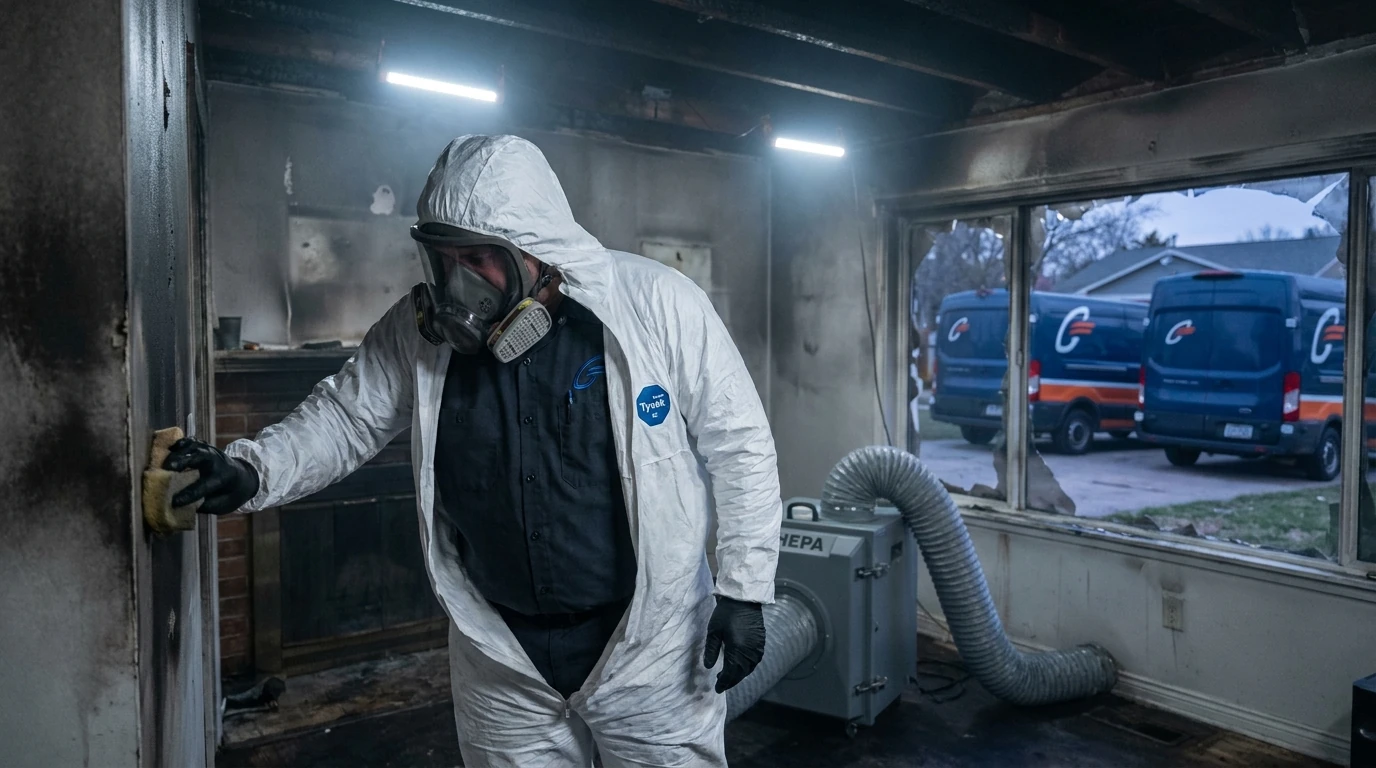
Phase 1: Emergency stabilization (Day 1-2). Secure the structure, extract standing water from suppression efforts, set drying equipment, and begin air quality control with HEPA air scrubbers. The goal is stopping the damage clock.
Phase 2: Contents inventory and pack-out (Day 2-5). Salvageable contents are inventoried, packed, and moved to a climate-controlled storage facility for cleaning. Non-salvageable items are documented for the insurance claim. This step protects your belongings from ongoing smoke exposure and gives the crew clear access to the structure.
Phase 3: Structural cleaning and deodorization (Day 3-14, depending on scope). Soot is removed from all surfaces using dry chemical sponges, HEPA vacuuming, and wet cleaning methods matched to the surface type. Porous materials that cannot be cleaned, such as heavily contaminated drywall or insulation, are removed. Thermal fogging or hydroxyl generation treats odor at the molecular level throughout the structure. HVAC ductwork is cleaned separately.
Phase 4: Reconstruction (varies). Once the structure is clean, dry, and deodorized, rebuild begins. This includes drywall, insulation, flooring, cabinetry, and paint. A general contractor with restoration experience can handle this phase as a continuation of the same project rather than a handoff to a separate trade.
For a deeper look at each phase, our post on the fire damage restoration process walks through the technical details.
Will homeowners insurance cover fire and smoke restoration in Enterprise, NV?
Standard homeowners insurance policies cover fire damage, including smoke and soot damage, as a named peril. This means both the structural repair and the contents loss are typically covered, subject to your deductible and policy limits.
What affects your payout:
- Documentation quality. A line-item scope from a certified contractor gives the adjuster a defensible number. A vague estimate invites lowballing.
- Contents inventory. Every item you can document with photos, receipts, or serial numbers strengthens your claim. Your restoration contractor should produce a formal contents list.
- Cause of fire. Fires caused by the homeowner’s negligence are still covered under most policies. Intentional fires are not. Fires caused by a tenant in a rental property are a more complex coverage question.
- Additional living expenses (ALE). If the home is uninhabitable, most policies cover temporary housing and meal costs while restoration is underway. Open this coverage with your insurer on day one.
The Insurance Information Institute has a plain-language guide to homeowners fire coverage that is worth reading before you meet with your adjuster.
One practical note: your insurance company may suggest a preferred contractor. You are not required to use them. In Nevada, you have the right to choose your own licensed contractor. The insurer pays the claim; you control who does the work.
How do you choose the right fire restoration company in Enterprise?
Choosing the right contractor after a fire is one of the highest-stakes decisions you will make in the next 48 hours. Here is what to verify before signing anything.
IICRC FSRT certification. This is the industry credential specific to fire and smoke restoration. It means the technician has been trained in the S700 standard. Ask for the certification number and verify it at iicrc.org.
Nevada contractor license. Fire restoration that includes structural work requires a licensed contractor. Nevada’s Contractors Board (NSCB) maintains a public license lookup. A restoration company doing reconstruction in Enterprise must hold a valid Nevada license. Desert Valley Contracting Inc holds Nevada license 0072652-B & B6.
Written scope before work begins. Never authorize work based on a verbal agreement. A written, line-item scope protects you if there is a dispute with the insurance company or the contractor.
24/7 availability. Fires don’t happen on business hours. A company that can respond the same night limits secondary damage significantly.
General contracting capability. If the company can only do the cleaning and deodorization but not the rebuild, you are managing two separate contracts, two separate schedules, and two separate insurance invoices. A firm that handles mitigation through reconstruction under one license simplifies everything.
Desert Valley Contracting Inc is an IICRC Certified Firm with FSRT (Fire & Smoke) and WRT (Water) credentials, serving Enterprise and the surrounding Las Vegas Valley 24 hours a day. If you are dealing with fire or smoke damage right now, call (702) 633-5033 to schedule an emergency assessment.
Video Transcript
A house fire leaves behind more than char. Smoke, soot, and water damage from firefighting hoses all need professional attention, fast. In the first 24 hours, document everything. Photograph every room, every ceiling, every cabinet before anyone touches a thing. That footage protects your insurance claim. Call your insurance company immediately to open a claim. Then call a certified restoration contractor. Don’t wait, secondary damage grows by the hour. And whatever you do, leave your HVAC off. Smoke particles inside the ducts will spread through your entire home the moment that system runs. Phase one is emergency stabilization, boarding up openings, extracting water, and running HEPA air scrubbers to stop damage from spreading any further. Next, salvageable belongings are carefully inventoried and packed out to a clean facility. Everything non-salvageable gets documented for your insurance adjuster. Then comes deep cleaning, dry sponges, HEPA vacuums, and thermal fogging to neutralize smoke odor at the molecular level, not just mask it. Once the structure is clean and dry, reconstruction begins, new drywall, flooring, cabinetry, and paint, all under one coordinated contract. Look for a contractor with IICRC certification and an FSRT credential. That means they’re trained to the national standard for fire and smoke restoration. After a fire in Enterprise or anywhere in the Las Vegas area, call Desert Valley Contracting Inc at 702-633-5033 for a free estimate. They’ll handle every phase.